
Asset-Based Economy vs Consumption-Based Economy
2026-01-12
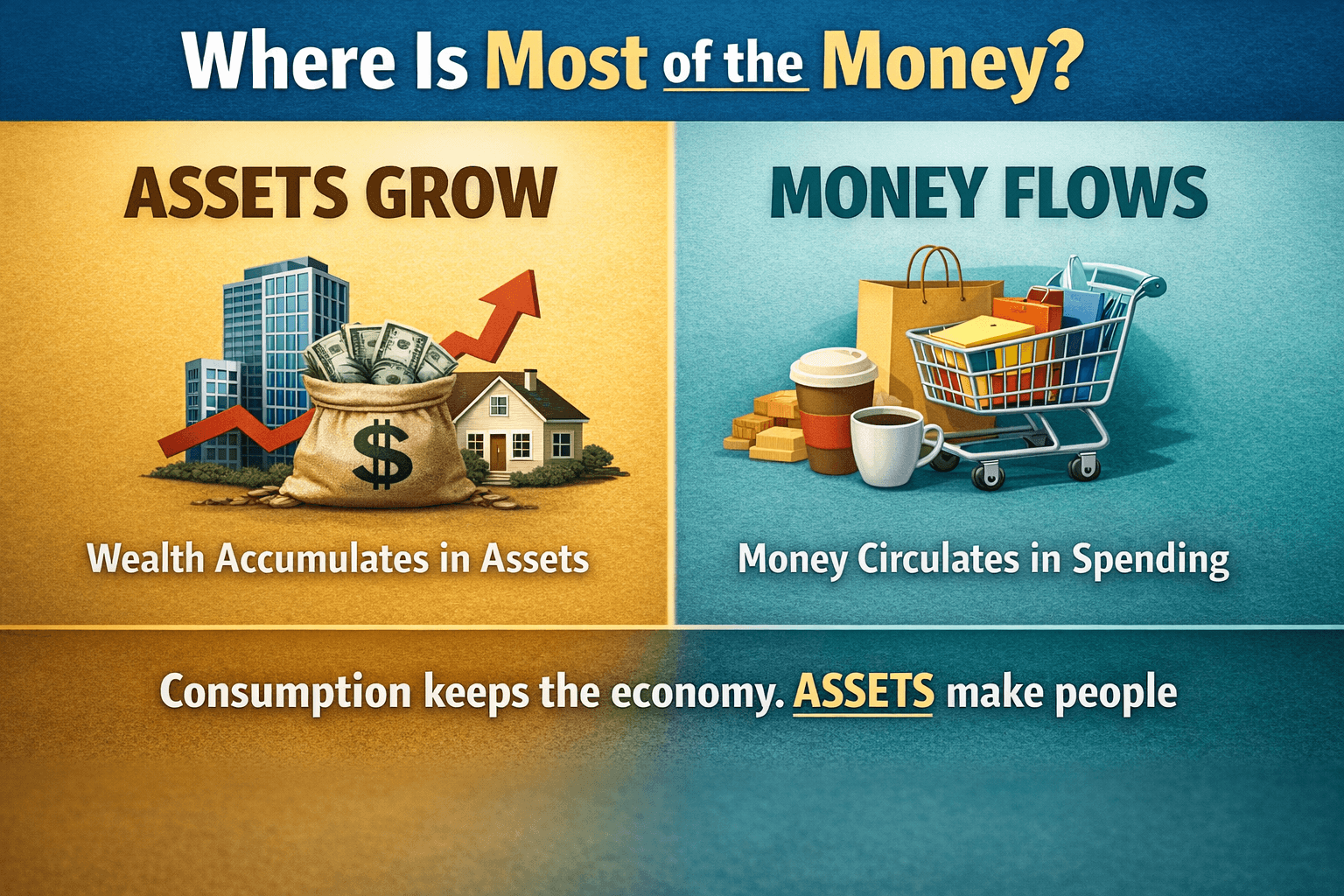
Asset-based economy vs consumption-based economy
Why ownership matters more than spending.
Most people are taught that working harder and spending wisely leads to financial security. In reality, the modern economy rewards ownership, not consumption.
To understand why, you need to understand the difference between a consumption-based economy and an asset-based economy.
What is a consumption-based economy?
A consumption-based economy runs on spending.
People exchange time for money, then money for goods and services. Economic growth depends on consumers buying more—food, housing, subscriptions, entertainment, and lifestyle upgrades.
In this system:
- Income is tied to labor
- Money is spent once
- Purchasing power declines over time
If people stop spending, the economy slows. This is why consumer confidence, credit, and stimulus are constantly emphasized.
What is an asset-based economy?
An asset-based economy runs on ownership.
Capital is used to buy or create assets that appreciate or generate cash flow—stocks, real estate, businesses, private equity, hedge funds, intellectual property, and digital assets.
In this system:
- Income is tied to capital
- Money is reinvested, not consumed
- Wealth compounds over time
This is where long-term wealth is actually created.
Where most capital really lives
Only a small percentage of people own the majority of capital in the world.
That capital is not used to buy material goods. It is deployed into assets. Hedge funds, institutional portfolios, venture capital, and private markets recycle capital continuously instead of spending it.
More than 90 percent of global capital operates inside the asset-based economy, not the consumption-based economy.
Most people never interact with this layer. They live in the consumption layer—wages in, expenses out. The asset layer sits above it, quietly compounding.
This creates a structural divide:
- Consumers spend money once
- Asset owners deploy money repeatedly
Why money is losing value
The value of money decreases when it is not invested.
Inflation does not just make things more expensive. It makes idle money weaker. Cash held in checking accounts or used only for consumption steadily loses purchasing power.
Asset owners protect themselves by converting money into assets designed to outpace inflation. As governments create more money, that money flows first into assets, not everyday goods.
This explains why:
- Wages struggle to keep up
- Asset prices rise faster than inflation
- The wealth gap continues to widen
It is not just that things cost more. Money itself is worth less unless it is positioned inside the asset-based economy.
Compounding vs resetting
Consumption resets to zero.
You work, you earn, you spend, and the cycle restarts. No matter how efficient you are, the system requires constant input.
Assets compound.
They grow while you work, while you sleep, and even when you stop working. Over time, compounding creates outcomes that labor alone cannot match.
This is why effort feels increasingly disconnected from results for many people.
The system is not broken
The economy is not failing. It is functioning exactly as designed.
It rewards:
- Ownership over labor
- Capital over consumption
- Reinvestment over spending
Technology has lowered the barrier to asset ownership—stocks, global markets, digital products, software, content, and small online businesses are more accessible than ever.
But behavior has not changed. Most people still optimize their lives around consumption, not ownership.
The practical takeaway
You do not need to stop consuming.
You need to start owning.
Even small assets change incentives. A single stock, a side project, equity in a product, or ownership of something that compounds shifts you from participant to owner.
The asset-based economy already exists. Most capital already lives there.
The only real question is whether you are positioned to benefit from it—or remain trapped in the consumption loop.