
OKRs: The Goal-Setting Framework That Actually Works
2026-02-07
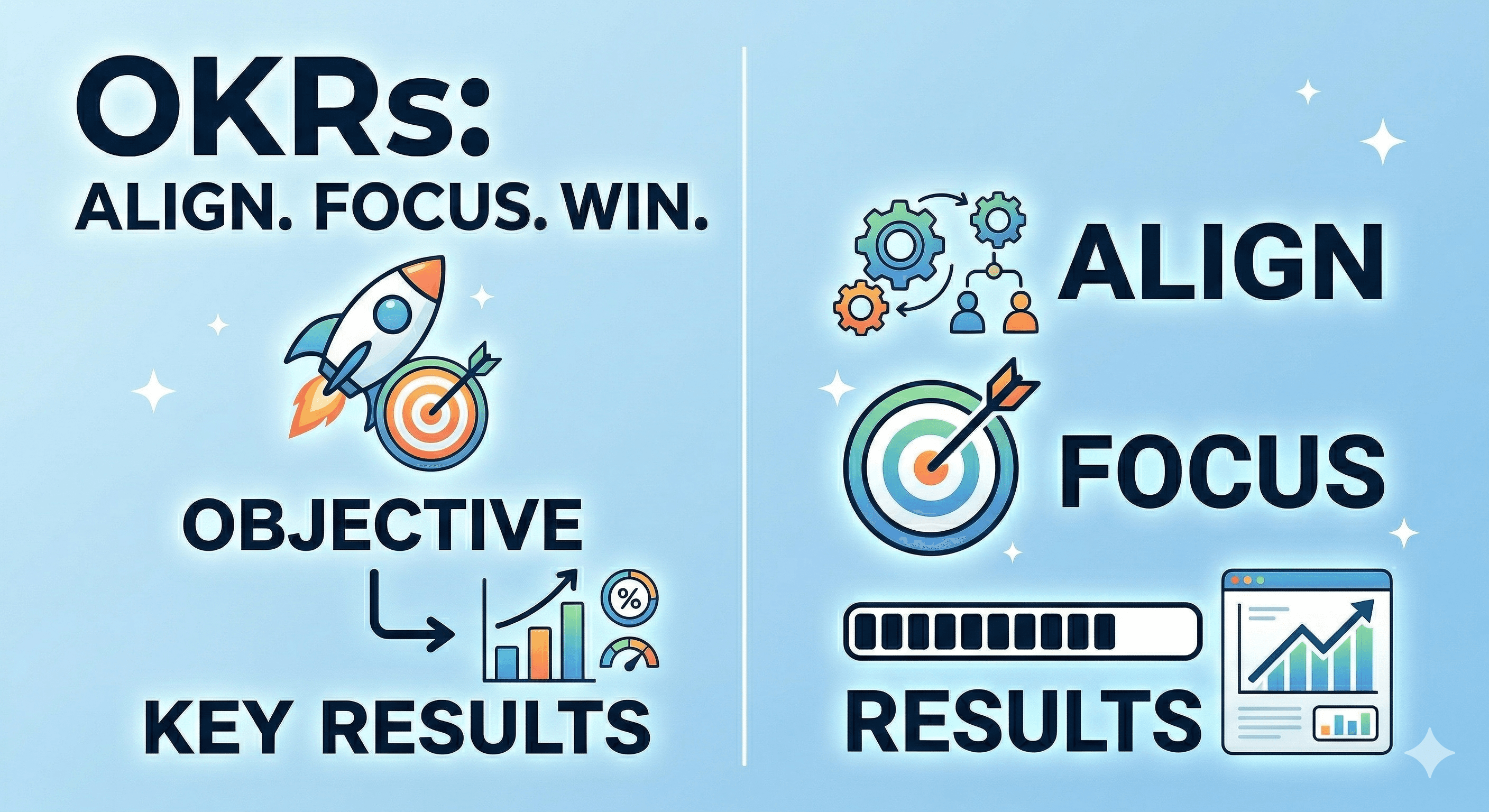
Most companies set goals that gather dust. OKRs — Objectives and Key Results — are the antidote: a simple, battle-tested system that keeps teams focused, aligned, and honest about what they're actually achieving.
Walk into most companies and ask what the top three priorities are. You'll get five different answers from five different people. Not because the strategy is secret — but because no one ever made it concrete, measurable, or visible. Goals live in a deck that was shared once in an all-hands and never opened again.
OKRs were built to fix exactly that.
What is an OKR?
OKR stands for Objective and Key Results. It's a goal-setting framework with two distinct parts working together.
The Objective is qualitative and inspiring. It answers the question: where do we want to go? Think of it as the direction — ambitious, motivating, and clear enough that any team member could repeat it without a slide deck.
The Key Results are measurable outcomes that define what "getting there" actually looks like. They answer: how will we know we arrived? Good key results have numbers. If you can't measure it, it's not a key result — it's a task.
Here's what that looks like in practice:
Objective: Make our product the most trusted tool for freelance invoicing
- Key Result 1: Grow monthly active users from 50k to 150k
- Key Result 2: Achieve a customer NPS of 60 or above
- Key Result 3: Reduce invoice creation time from 8 minutes to under 2
Notice how the objective sounds like something you'd put on a poster, while the key results read like a scorecard. That tension is intentional. Together, they force a team to be both bold and accountable.
"If you hit 100% of your key results every time, you're not aiming high enough."
A real-world example
Google is probably the most famous OKR success story. John Doerr introduced the framework to Larry Page and Sergey Brin in 1999, when the company had fewer than 40 employees. They adopted it — and never stopped. Google credits OKRs as a core driver of how it scaled from a scrappy startup to one of the largest companies in the world.
Here's what a Google-style OKR might have looked like in the early days of Gmail:
Objective: Make Gmail indispensable for power users
- Key Result 1: Reach 1 million active users within 6 months of public launch
- Key Result 2: Achieve a 30-day retention rate of 65% or higher
- Key Result 3: Reduce average email load time to under 1 second
- Key Result 4: Keep support tickets below 0.5% of daily active users
The objective is vivid and directional. The key results are hard numbers with clear deadlines. Any engineer, designer, or PM on the team could look at this and immediately know what success looks like.
Why companies use OKRs
Plenty of goal-setting frameworks exist. OKRs have survived decades and spread across industries because they solve real, recurring problems in how organizations operate.
- Focus. OKRs force a company to pick what actually matters. Most teams can only handle three to five real priorities per quarter — the framework makes you choose.
- Alignment. OKRs cascade from the company level down to teams and individuals. Everyone can see how their work connects to the big picture, which reduces silos and duplicate effort.
- Ambition. OKRs are designed to be stretch goals. Hitting 70% of a moonshot beats hitting 100% of something safe. The framework gives teams permission to aim high.
- Transparency. OKRs are public within the company. Anyone can see what any team is working toward, which builds trust and surfaces conflicts early.
The most common OKR mistakes
OKRs are simple to understand and hard to do well. A few patterns consistently trip teams up.
Confusing outputs with outcomes.
"Launch the new dashboard" is an output — it describes work done, not value delivered. A good key result might be: "New dashboard reduces time-to-insight for analysts from 45 minutes to under 10." The launch is the means; the behavior change is the result.
Setting too many OKRs.
If everything is a priority, nothing is. Most teams do best with one or two objectives per quarter, each with two to four key results.
Tying them to performance reviews.
OKRs should not be linked directly to compensation or bonuses. When people are graded on their OKRs, they start sandbagging targets. The whole point of the framework is to encourage ambitious goal-setting — that only works if people feel safe aiming high and falling short.
Getting started
You don't need software, a consultant, or a company-wide rollout to try OKRs. Start with one team, one quarter, and three honest questions: what's the most important thing we want to accomplish? How will we know we got there? And — crucially — are we willing to make this visible and check on it regularly?
The framework is almost embarrassingly simple. The discipline is in actually using it.